
Every renovation starts with a vision. At some point, that vision meets a budget, and the first question most people reach for is a cost per square foot ($/sq. ft).
It’s a reasonable instinct. When you’re preparing for what might be one of the largest investments of your life, a single number feels grounding. This is one that is familiar, due to its use by realtors and developers. You hear it all the time: “this project was created for x-amount of dollars per square foot,” or more popularly used by realtors to justify how much a property should sell for in a particular neighbourhood, due existing comparisons.
This metric can be misleading in so many ways! The challenge is that renovations rarely work that way. There are too many variables, and too many unknowns hiding within existing walls for one metric to tell the full story.
Here’s what that number is actually telling you, and what it is leaving out.
A Metric Built for a Different Era
Cost per square foot has its roots in the 1900s and was used by builders and appraisers to determine a standard rate to build. Then in post-World War II North America, when developers were building thousands of homes at a time, the metric became a norm. Homes were nearly identical - same footprint, same ceiling heights, same finishes, repeated across entire subdivisions. In that context, dividing total cost by total square footage was a practical way to plan and compare. Every unit was essentially the same product.
From there, the metric carried over into real estate. Realtors use it today to benchmark comparable properties against one another, and for that purpose it still works reasonably well for them. The issue is when the same shorthand crosses over into custom construction and renovations, where no two projects share the same variables, the same scope, or the same existing conditions. Those figures started feeling like commitments, and that is where things tend to go sideways.
New builds vs Renovations
That said, the metric is not without merit. Where it tends to hold up is in new construction. When you are starting from scratch, every material, system, and decision is made before a shovel hits the ground. A builder can look at your plans and develop a reasonable picture of what the project involves, because they’re pricing-known choices.
Renovations are a different conversation. When you renovate, you’re working within an existing structure, one that comes with its own history. What is behind the walls? What condition are the pipes and electrical in? What will the building require before work can begin? These are not questions with predictable answers, and each one has a direct impact on your budget.
This is why renovation costs in the Lower Mainland can range anywhere from $100 to $500 per square foot, as that range spans across various scopes of works and the type of building being renovated, in addition to they type of finishes. That range is an honest reflection of how different two projects can be. A focused refresh with mid-range finishes looks nothing like a full structural transformation with premium materials and complex permitting & logistics. Both are renovations with the same square footage, but the projects are not.
What Actually Drives Your Budget
Square footage is rarely the deciding factor. The choices that move a renovation budget most significantly happen before a single wall comes down.
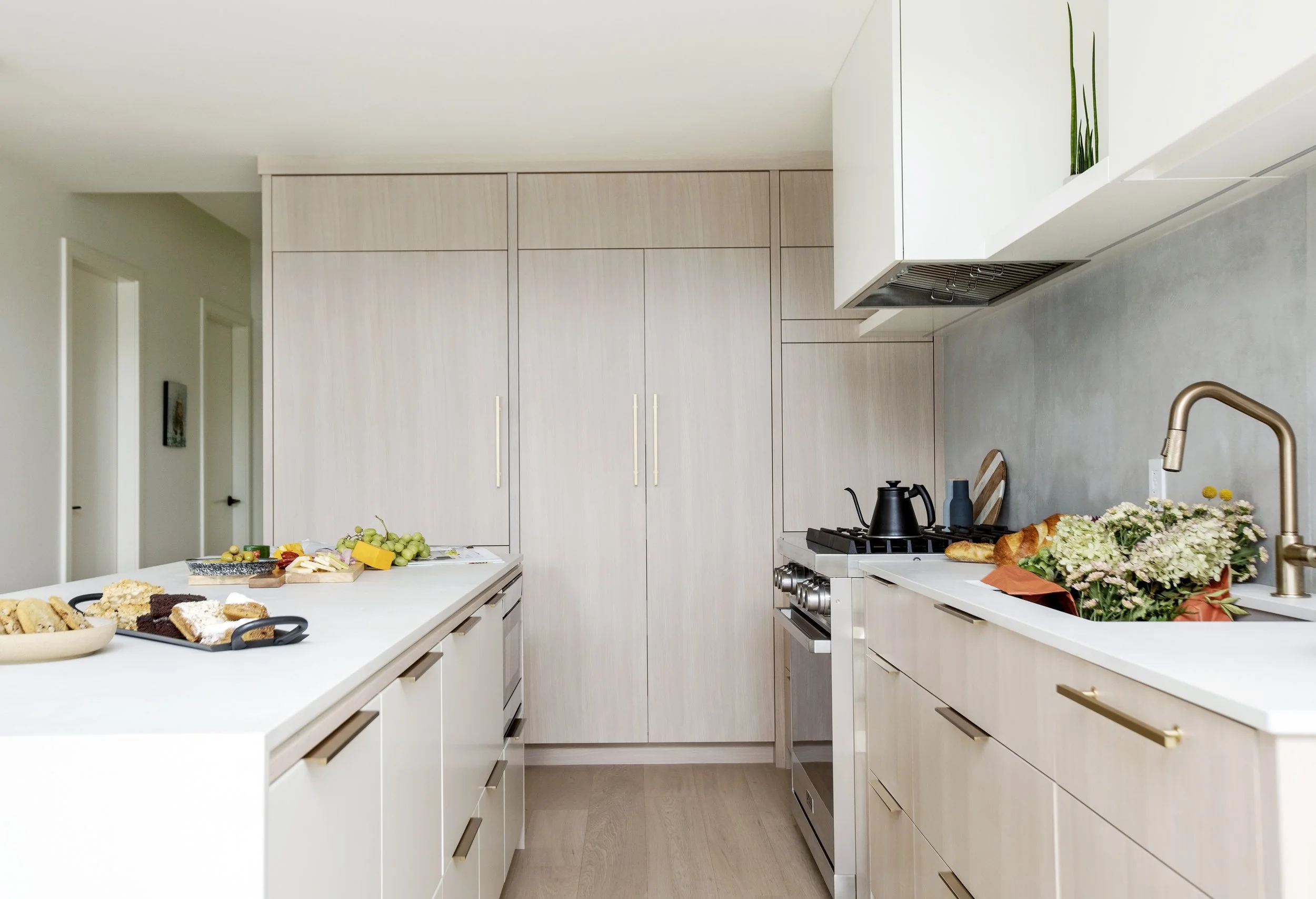
Take two kitchens with the same footprint. One has standard grade cabinetry and baseline quality countertops, or something we refer to in the industry as the “developer special.” The other has custom millwork, designer selected surfaces, and professional-grade appliances, complimented with designer handles/hardware and fixtures. Same square footage, but two very different projects. Finishes shape budgets in ways that floor measurements simply cannot, as does the extent of scope to deconstruct, transport/deliver, and execute the project based on site logistics.
Beyond finishes, there are costs that rarely appear in a per-square-foot figure at all, and are often referred to as soft-costs. These include:
Architecture and design
Engineering
Permits
Project management
These soft-costs are the foundation of a well-run project. Leaving them out of an early estimate does not make the project less expensive. What it does is make the first conversation easier, and every conversation after significantly harder.
Inversely, hard-costs are all the labour and materials that go into physically building the project.
Condo Renovations Carry an Extra Layer
For condo owners, the variables go even further. Strata Bylaws, council approvals, shared building systems, obedience to hours of work, protection of common areas, and neighbour coordination all factor into what is possible, what requires documentation, and how long the renovation process will take. These points are challenging to capture in a price per square foot estimate, as they are unique to every project. Add to this the laborious logistical challenges, and you’ve just increased your project timeline, that in-turn alters costs.
Condoworks was built around this exact complexity. Our team comes to each project with a working understanding of how condo buildings are constructed, often before the drawings are even reviewed. Two units on the same floor, with the same layout can represent entirely different scopes of work once you look closely at what the renovation actually requires.
Better Questions to Bring to Your Builder
Leading with context rather than a $/sq. ft number will serve you far better. Some of the most useful questions you can bring to an early conversation include:
What drives cost in a project like mine, specifically?
Can we work backwards from a target budget to shape the design?
What existing conditions might affect what we find once work begins?
What is included in your estimate, and what is not?
At Condoworks, this is how we prefer to start. Understanding what drives your project before a number is ever put on paper means fewer surprises, clearer decisions, and a finished result you can feel confident in. Hence, building a contingency into budgets that allows us a dollar buffer in-case unforeseen factors creep up.
We've guided many homeowners through this process across the Lower Mainland, and we'd be glad to do the same for you. If you're thinking about a renovation, we'd love to be your first call. Contact us below.
